
In brief
- In 2024–2026, every China–Iran train with a published routing left China at Khorgos–Altynkol and entered Iran at Incheh Borun or Sarakhs, changing gauge twice.
- Reports from July 2024 to September 2026 put China–Iran rail transit at about 14–18 days, before any waiting at congested borders.
- Iranian ports, including those on the Gulf of Oman, have been under a US naval blockade since 14 July 2026, and ships bound to or from them are being redirected.
- In normal conditions, direct sailings from China to Bandar Abbas took about three weeks port to port (carrier schedules from 2006 and 2018).
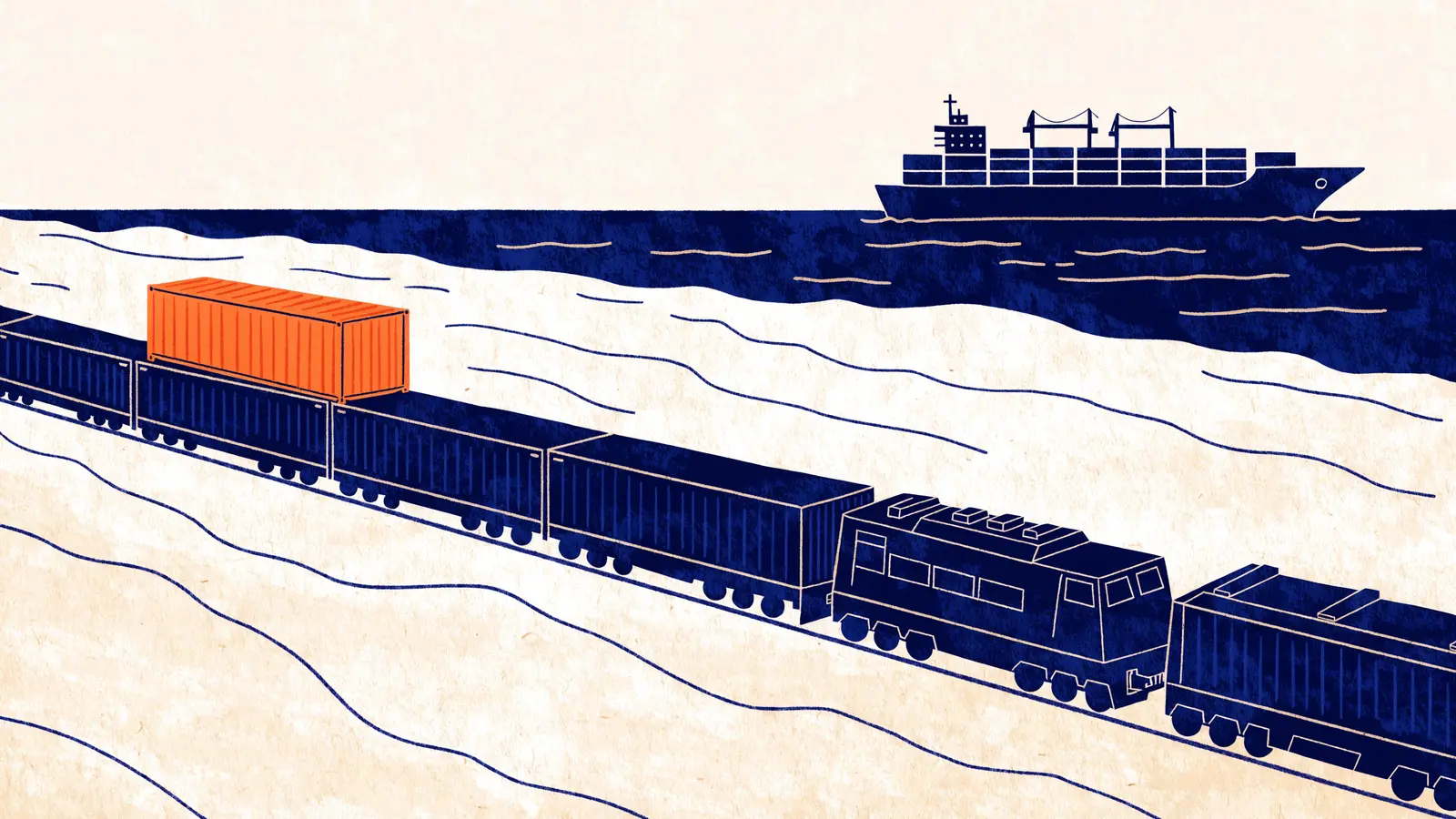
Goods between China and Iran travel mainly on two routes: by rail across Central Asia, or by sea through the Strait of Malacca and the Strait of Hormuz to Iran’s southern ports. In October 2026 the two are in very different states. This guide explains how each works, how long each takes and when each fits. The current status is in our corridor note for October 2026.
Which rail routes run from China to Iran?
Every China–Iran train with a published routing in 2024–2026 left China at Khorgos (Altynkol on the Kazakh side) and entered Iran at either Incheh Borun or Sarakhs. The main line crosses Kazakhstan, passes into Turkmenistan at the Bolashak crossing and reaches Iran at Incheh Borun, then continues via Gorgan towards Tehran. This Kazakhstan–Turkmenistan–Iran line opened in December 2014, and pilot trains used it in both directions in July 2024.
The second entry point is Sarakhs, which an Iranian rail operator describes as Iran’s busiest rail border crossing and one that trains from China have also used (RWT, November 2025). On 7 September 2026 the first block train from China to Iran via Uzbekistan left Altynkol with 55 containers, routed through Kazakhstan, Uzbekistan and Turkmenistan to Sarakhs.
In Iran, trains from China run to Tehran’s Aprin dry port, about 20 km from the city, whose first phase opened on 6 March 2023. In China the services run under the China–Europe Railway Express (中欧班列) brand. KTZ Express, the logistics arm of Kazakhstan’s railway, reported a fourfold rise in volumes on the China–Kazakhstan–Turkmenistan–Iran route in 2025.
| Via Incheh Borun | Via Uzbekistan to Sarakhs | |
|---|---|---|
| Exit from China | Khorgos–Altynkol | Khorgos–Altynkol |
| Transit countries | Kazakhstan, Turkmenistan | Kazakhstan, Uzbekistan, Turkmenistan |
| International borders | 3 | 4 |
| Gauge changes | 2 | 2 |
How long does rail take from China to Iran?
Reports from July 2024 to September 2026 put rail transit time from China to Iran at about 14–18 days. These figures describe individual trains or operators’ statements, not a published timetable.
| Train or service | Reported time | Report date | Source |
|---|---|---|---|
| Xi’an → Tehran pilot, via Bolashak | 15 days | July 2024 | News Central Asia |
| Aprin → China return pilot | 12 days | July 2024 | KTZ Express |
| Xi’an → Aprin, first direct service (May 2025) | about 15 days | June 2026 | The Diplomat |
| Existing services via Central Asia | 14–18 days | September 2026 | Asia-Plus |
| Block train via Uzbekistan | 14–16 days, planned | September 2026 | Asia-Plus |
As of 8 October 2026 no arrival report had been published for the Uzbekistan block train, so its 14–16 days is a plan, not a result. Border time is not always included: at peaks in 2024–2025, shipments were held at Kazakhstan’s border crossings with China for up to a month (RailFreight.com, December 2025).
How are gauge changes and rail documents handled?
Every China–Iran train changes gauge twice, because China and Iran use standard gauge (1,435 mm) while Kazakhstan, Uzbekistan and Turkmenistan use broad gauge (1,520 mm).
At the China–Kazakhstan border, containers are lifted from one train to the other. The Chinese rail port at Khorgos completed this for an inbound train every two hours on average in 2025 (Xinhua, January 2026), and KTZ Express raised capacity at the Khorgos Gateway dry port to 800,000 TEU a year (February 2026).
The second change is at the Turkmenistan–Iran border. The July 2024 pilot changed gauge at Etrek terminal in Turkmenistan. At Sarakhs, Iran’s railway runs a bogie exchange facility with a capacity of 400 wagons a day, according to Iran’s railways (UNESCAP, 2019). An Iranian rail operator puts the daily wagon interchange capacity at the Sarakhs border at about 400 wagons, with fewer than 150 interchanged on average (RWT, November 2025). Published sources do not say whether China–Iran containers at Sarakhs are lifted or moved by bogie exchange.
On paperwork, China, Kazakhstan, Uzbekistan, Turkmenistan and Iran are all parties to SMGS, the international rail freight agreement. SMGS allows carriage across two or more countries “under a single document (consignment note) issued for the whole route”, so one SMGS note from China to Iran is legally possible. No railway or operator source confirms that every China–Iran train moves on one note end to end, so confirm it with the operator. Our guide to shipping documents for Iran–China trade covers the rest.
What slows the rail route down?
The main constraints on China–Iran rail in 2025–2026 are borders, congestion, wagons and one-way flows.
- Three or four borders. Via Incheh Borun a train crosses three international borders; via Uzbekistan it crosses four. Customs procedures along the route “are not yet fully harmonized” (The Diplomat, June 2026).
- Khorgos. The crossing is “heavily congested across both rail and road” (RailFreight.com, 22 June 2026). Kazakhstan has raised the maximum number of trains allowed through Altynkol from 8 to 15 (RailFreight.com, December 2025).
- Bolashak. The Bolashak crossing into Turkmenistan is “a single-point bottleneck” for China–Iran rail freight on the Incheh Borun line (The Diplomat, June 2026). The Uzbekistan routing avoids it.
- Wagons. In August 2025 Iran and Turkmenistan discussed a freight backlog at Sarakhs, and 200–300 more wagons were to join the joint fleet (Tehran Times, August 2025).
- One-way flows. Traffic runs mostly one way, from China to Iran (The Diplomat, June 2026).
How does the sea route work in normal conditions?
In normal conditions, containers sail from Chinese ports through the Strait of Malacca and the Strait of Hormuz to Bandar Abbas, and published direct schedules gave about 18–19 days port to port.
Direct services to Iran have loaded cargo at Shanghai, Ningbo, Xiamen, Shenzhen, Qingdao, Tianjin, Dalian and Lianyungang. Ships cross the Indian Ocean and the Gulf of Oman, often calling at Jebel Ali in the UAE, and discharge at Shahid Rajaee port at Bandar Abbas.
CMA CGM gave 19 days from Shanghai to Bandar Abbas in January 2018, and Wan Hai gave 18 days from Lianyungang in 2006. These schedules are old. No current direct schedule was found, and the situation in 2026 is different.
What is the status of the sea route in October 2026?
Iranian ports, including those on the Gulf of Oman, have been under a US naval blockade since 14 July 2026, and ships bound to or from them are being redirected. Most major container lines are not routing through the Strait of Hormuz.
The blockade was first announced by US Central Command on 12 April 2026, lifted in June and reinstated from 14 July 2026. Commercial traffic through the Strait of Hormuz has been far below normal since March 2026. In its 30 September 2026 brief, Lloyd’s List Intelligence counted 15 container-ship transits of the Strait by non-Iranian-linked vessels so far in September, and noted that “major lines continue to avoid the area”.
At Shahid Rajaee, port calls averaged about 0.7 a day in September 2026, against about 2.7 a day in the year before March 2026 (IMF PortWatch, satellite ship-tracking data). Ship-tracking (AIS) counts miss ships that sail with their transponders off, so treat the figure as an indicator, not a full count.
Is the Caspian rail–sea route an alternative?
The Caspian rail–sea route is used for some cargo in 2026, but capacity on the Caspian is limited.
Cargo goes by rail across Kazakhstan to Aktau, then by ship to an Iranian Caspian port such as Anzali or Amirabad. A Yiwu–Anzali service used this route; its transit times were unstable because of limited Caspian shipping capacity and extreme weather, and in July 2024 an all-rail return service from Iran to Yiwu was launched (Yiwu Municipal Government, July 2024).
In September 2026 the head of the Mazandaran free zone said cargo from China via Kazakhstan had recently entered Amirabad port (Tehran Times, 16 September 2026). Trans-Caspian shipping is constrained by “a shortage of vessels and falling sea levels” (The Diplomat, June 2026).
What this means for you
For containers, rail through Central Asia is the route operating between China and Iran in October 2026. Bulk cargo usually moves by sea, and sea access to Iranian ports is constrained under the blockade; the Caspian route takes some cargo, with limited capacity.
- Containers: plan on the reported 14–18 days plus border time, and check space on the train.
- Before booking: confirm the border crossing, the gauge-change point and the consignment note.
- Terms: the right Incoterms rule depends on the mode; see our guide to Incoterms for Iran–China trade.
Mehan’s trade desk publishes the current corridor status and a route planner.
Common questions
- How long does rail freight take from China to Iran?
- Reports from July 2024 to September 2026 put it at about 14–18 days, and one 2024 return pilot was reported at 12 days. Waiting at congested borders, especially Khorgos, can add time.
- Where do China–Iran trains cross into Iran?
- At Incheh Borun, after crossing Kazakhstan and Turkmenistan, or at Sarakhs. A first block train via Uzbekistan to Sarakhs left Altynkol on 7 September 2026.
- Can one rail consignment note cover the whole route from China to Iran?
- Legally yes: China, Kazakhstan, Uzbekistan, Turkmenistan and Iran are all parties to SMGS, which allows one consignment note for the whole route. Confirm with the rail operator how your shipment will be documented.
- Is the sea route from China to Iran open in October 2026?
- Iranian ports, including those on the Gulf of Oman, have been under a US naval blockade since 14 July 2026, and ships bound to or from them are being redirected. Most major container lines are not routing through the Strait of Hormuz.
Sources
- First block train from China to Iran launched via Central AsiaAsia-Plus
- China, Kazakhstan, Turkmenistan and Iran Develop New Transport RouteNews Central Asia
- KTZ Express and China Railway Container Transport Co. Ltd. Resume Iran-China Transport RouteKTZ Express
- 中欧班列“库姆(伊朗)—义乌”全铁路回程班列开行Yiwu Municipal Government (义乌市人民政府)
- Can Kazakhstan and Iran Sustain Momentum on Transport Corridor Development?The Diplomat
- Visit of Senior Managers of the RWT to the Sarakhs Terminal in TurkmenistanRWT
- Statement of the Railways of the Islamic Republic of Iran to the Working Group on the Trans-Asian Railway Network (December 2019)UNESCAP
- Largest dry port near Tehran inauguratedMehr News Agency
- KTZ Express reports 2025 resultsKTZ Express
- “义乌—德黑兰”班列首发People’s Daily Overseas Edition (人民日报海外版)
- 2025年霍尔果斯开行中欧(中亚)班列9882列Xinhua, via Belt and Road Portal (中国一带一路网)
- Agreement on International Railway Freight Communications (SMGS)OSJD
- 国际铁路货物联运协定(国际货协)National Railway Administration of China (国家铁路局)
- Data of the week: A maturing Middle Corridor runs into growth painsRailFreight.com
- Sarens expands congested Khorgos border crossing: “Altynkol connection in 2-3 years”RailFreight.com
- Iran, Turkmenistan agree to build 2 new rail lines at Sarakhs borderTehran Times
- CMA CGM restarts third Iran–Asia direct serviceSeatrade Maritime
- Wan Hai to add Iran calls to China-Middle East-India serviceFreightWaves
- U.S. to Blockade Ships Entering or Exiting Iranian PortsUS Central Command
- Report on the reinstated blockade of Iranian ports from 14 July 2026Xinhua (cnfin.com)
- US military to enforce renewed blockade of Iranian ports, CENTCOM saysAPA
- Strait of Hormuz Brief: 30 September, 2026Lloyd’s List Intelligence
- Bandar Shahid Rajaee: daily port calls (satellite AIS, data to 2 October 2026)IMF PortWatch
- Northern ports; driver of Iran’s trade development with EurasiaTehran Times
General information, not legal or customs advice. Rules and routes change; check the current position before you ship.